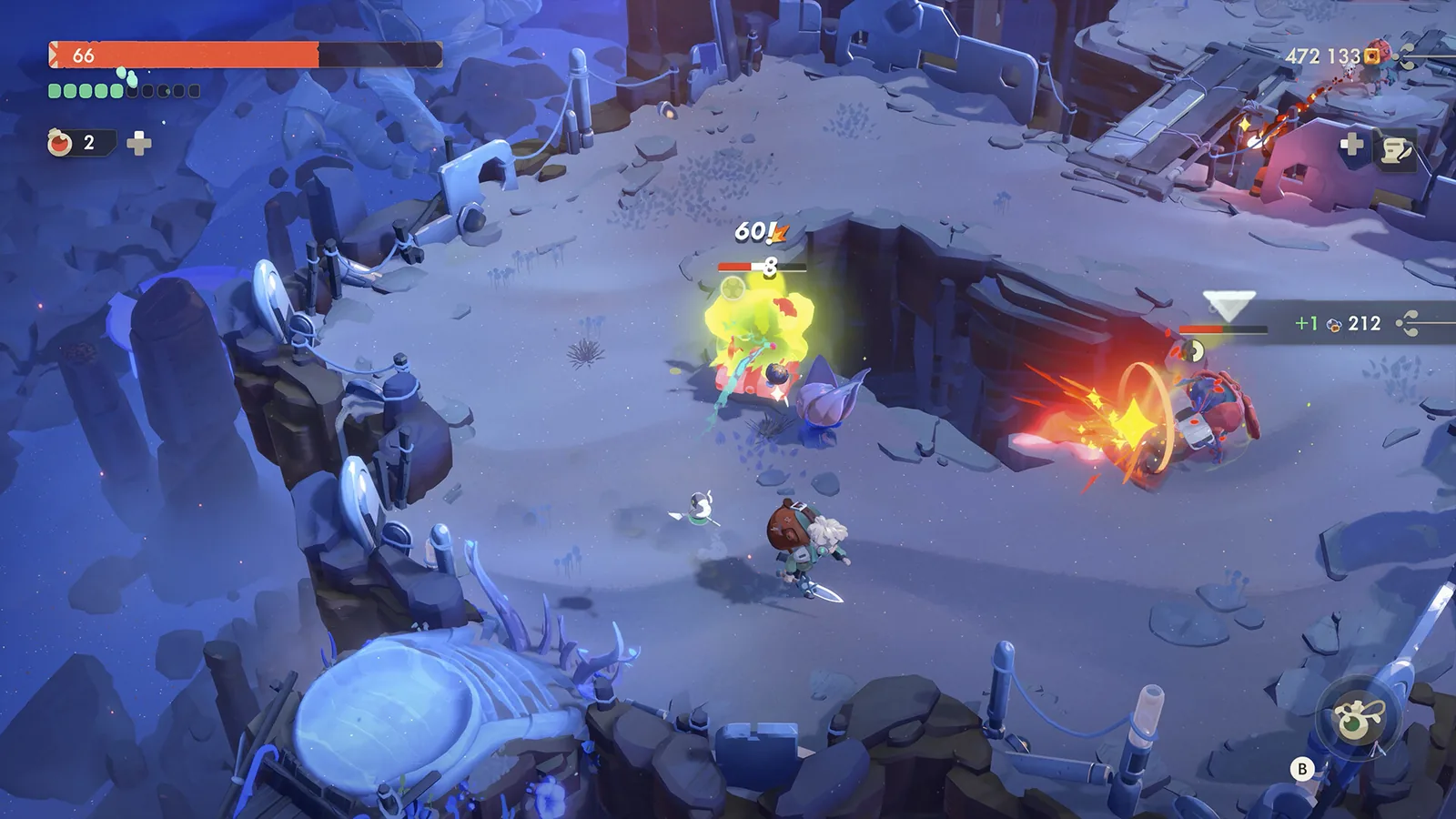
There are five attack types: the three-hit normal string, the fourth-hit finisher, the special, a special finisher, and gadget/gun damage. Route toward perks and pedestal modifiers that feed one archetype — Thunder, Wound, Ice, Ignite or Poison — and treat movement as your real defense: footage shows regular enemies whiffing against a merchant who never stops moving.
The five attack types, in order
A detailed 1.0 mechanics breakdown lays the combat system out cleanly. Every weapon has a normal attack string; the fourth consecutive hit is a stronger attack finisher (the spear slams, blades do a high swing). The special attack and its finisher add two more buttons, and the gun rounds it out with ranged damage that consumes bullets. That is the whole toolkit — build depth comes from what modifies it.
Weapon choice still matters. Playthrough dialogue on crafting calls the short sword “the most balanced weapon” with a fourth-hit finisher and a special that hits enemies around you; the great sword trades speed for reach; the spear’s finisher slams. Craft order at the forge is a choice of spear, knuckles, short sword or great sword from materials.
Combat pedestals set your build
Each incursion offers combat pedestal pickups that modify the rest of the run — the breakdown’s example grants “your attacks grant 10% Thunder stack”, and it is blunt about duds like flat early-game modifiers that never scale. The discipline the source teaches is to read the pedestal before choosing anything else: if your pedestal feeds attack-speed Thunder, take Thunder perks, attack modifiers and fast strings from then on, rather than mixing five unfinished ideas.
- Thunder stacks from attacks detonate in an area burst — strong against dense rooms.
- Wound and Ice scale well with attack modifiers per the same breakdown.
- Ignite is described as workable but the weakest of the burn-style options in that source’s testing; Foam is called the worst.
- Poison carries dedicated Endless runs in community footage — a late-game scaling archetype.
Hit-and-run is the real meta
The same breakdown counts enemy attack cycles out loud — three, four hits, cooldown — and concludes that three attacks per opening, then repositioning, beats any greedy combo. Standing still is the only way most enemy attacks connect, which is why patient players out-DPS aggressive ones with the same gear.
Do not sleep on the gadget slot
Gadgets are the quiet third pillar next to weapon and perks. Playthrough footage shows gadget recipes being unlocked as run rewards — the official store screenshot of the Gallery’s exhibit hall captures the Blo-Blitz recipe, described as “the ultimate ambidextrous trial” that “lets you wreak havoc with both hands” — and the 1.0 notes add the Machine Gun gadget on top. Bullets refill from destructible scenery, per the mechanics breakdown, so a gadget-heavy build plans routes past breakables instead of running dry mid-arena.
What 1.0 added for builds
Official 1.0 notes introduced four Endless Weapon Aspects — Short Sword, Great Sword, Spear and Gauntlets — plus the Machine Gun gadget and Endless Armour, extending the build space past the Early Access arsenal. See the version 1.0 changelog page for the full split, or plan the run that funds these upgrades in the price guide.